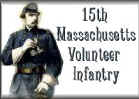
Research, letters and photo contributed by Kath Dietrich Note: a transcript of Eames's letter book is deposited with the U.S. Army Military History Institute, at Carlisle Barracks, Pennsylvania. |
|
Camp Foster Pooleville, Md Oct. 22nd 1861 My Dear Wife I have been at last into Virginia but did not stay long. At midnight, Sunday the sound of the "Long Roll" roused us and we were quickly on the march to the river. We crossed into Virginia early in the day. About 11 o'clock Co. B was sent forward to skirmish. We soon engaged the enemy's cavalry and we were obliged to fall back to our main body. In this skirmish we lost Capt. Simonds and some of our best men. Capt. Simonds started with me to fall back on the reserve but did not get in. Whether he was killed or captured I know not but I have reason to fear the former. There were of the 15th in the action 620 men and officers; a part of Baker's California Brigade; and a few other Massachusetts troops. Our force was a little more than 2000 men. We fought the Devils till dark and then retreated to the river where many surrendered. Eight hours and a quarter we stood before a terrific fire from greatly superior numbers. The woods were swarming with the fellows. General Baker who was in command on our side was killed. He fell pierced by seven bullets. His body was brought off the field. Lt. Col. Ward lost a leg. He was brought off and is doing well. The rebels shot us down like dogs after we had surrendered. A few managed to escape by swimming the river with the bullets falling like rain all around us. Many were shot and killed in the water. The orders was given for everyman to take care of himself. I saw Col. Devens and Major Kimball preparing to swim, so I stripped off all my clothing except my shirt, drawers, and socks and with colonel Devens, Lt. Eager, Fred Sibly, A.A. Simonds and George S. Ross we took some branches of trees for a partial support and struck out for the opposite shore which we succeeded in reaching. Oh, didn't the bullets sing merrily around our heads on the passage. The only thing that I saved was your picture in the locket. Tell Mr. Thompson that the big pipe is in the Potomac. We threw our arms and equipments into the river to prevent their being of service to the enemy. The Colonel and Major threw their swords as far as they could into the river. I pointed the bayonet into the mud and drive the piece down almost to the lock, leaving it as a mark to start from next time I travel into Virginia. Of the 620 men that we took into battle not over 200 came back. Half of our company (B) is missing. Of my mess all are here except George Gilchrist and Granville Hosmer. They are most likely prisoners. I thought that I would rather take my chance of drowning than fall into the hands of the enemy. Many of our poor fellows were drowned while trying to swim the river. It was awful to hear the death shrieks of the poor boys and to see them go under having no chance to help them and expecting to share in their fate. One whom I supposed to be SK Walker drowned near me when about halfway across the river. I found a couple of dry shirts when we landed and put them on and with 2 overcoats and a blanket that I managed to secure and wrap around me, I commenced my weary march of nine miles to camp. It was a rough journey as I was tired, hungry and my feet were protected only by socks. I got over it finely however, and taking a tremendous drink of gin I lay down and slept from midnight until this morning just as soundly as though rebel bullets had never been heard. I lost what money I had and the Testament you gave me. I shall get along well enough, however, for Col. Devens and Lt. Edgar are both indebted to me for their safety and will not, I think, let me want for anything. Our officers gave us the highest praise saying that we fought like veterans and did all that men could do. We saved our colors but they are riddled with bullet holes. George Daniels has two bullets shot through his arm but the wounds are not dangerous. I cannot write anymore just now. This will show you that I am safe. Your Affectionate Husband, Walter A. Eames |
Camp Foster, Poolville, Md. November 15, 1861 My Dear Wife I will try to write by daylight and try to do better than before. I shall tell you some more about the affair at Ball's Bluff. Henry Rich is all right. He did not get back to camp till about the last one. He and a fellow named Pope traveled some miles up the river and lay all night and part of the next day under a wheat stack and ate wheat to appease their hunger. The finally got a chance to cross the river in a boat and made their way back to camp being the last of our men who came back. All that I know about Stone is easily told. When the order was given to retreat I did not know it for I was having a little shooting match on my own. I missed Gilchrist and Brown from my side and turning to look for them, I saw the whole line marching precipitously down the bluff to the river. I followed but in the confusion I got mixed up with the Tammany fellows. I ran a short distance up the river and not finding any of our boys I turned back. I soon met Henry Whittemore who accosted me with, "For God's sake Eames, what shall we do?" I then proposed that we should try to swim to the island. He would not attempt it so I made him turn back with me to try and find the rest of our company. Just then a murderous volley was fired by the devils on the top of the bluff and we both sprang behind a large tree. Here Whittemore sank down, completely discouraged saying, "I can go no further. I shall die here." I tried to cheer him up and make him do something for himself but could not, and then I left him. This is the last that was known of him. A few paces from where I left him I met Lumen Stone who was also much discouraged. I proposed to him that we swim, but he would not try it. He said that he "hadn't trength enough to reach the island." I began to move away and he begged me not to leave him. "Come along then, " said I, "We have not time to waste." Soon we found the Colonel, Major, and Lt. Eager standing together. They were preparing to try the water. I began imitating their example as poor Stone stood by looking mournfully. After I stepped into the water he said, "Are you going Eames?" I answered, "Yes. And won't you come too?" He shook his head, and as I struck off he burst into tears and cried, "Goodbye, Eames, good-bye!" The poor fellow, how I pitied him but I could not help him. I can write no more just now. Your Affectionate Husband, Walter Eames |
Camp Foster, 15th Mass. Regt. Pooleville, Md. Nov 30, 1861 Dear Mother Your kind letter of the 24th inst. came to hand Thursday evening and was thankfully received. Letters from home are worth more to us than anything else and the cry of "the mail" will cause the boys to move a little more quickly than anything else perhaps excepting bullets. ...I did not think that after what I did for Col. Devens when we escaped from Ball's Bluff, that he would at least acknowledge it in some way. But he has not noticed me or made any allusion to it. If I had not held him up and talked to him more roughly than I ever did to any man, then he would never have set foot on land again. If I had his throat in my hands again as I did that night, I would grip it so that he would remember me. I don't wish to boast but others besides myself knew that I was instrumental in saving him. I'd like to get my fingers twisted in his beard as they were that night, just once more, for I think that I'd make him grieve. I don't know that I had any right to expect it but I did think he might do something for me in return for the service I did him, just enough to pay me for swearing at him as I did. I know that makes you feel badly, Mother, but it did cost considerable damning to get the old fellow across that river. His senses were so befogged that it took a great deal of strong language to make him realize that if we didn't all get going we were all going to meet at the bottom of the river. But enough of this. We shall probably remain the winter in tents here and picket on the Potomac between Edward's Ferry and Conrad's Ferry. I have run out of paper, news and daylight. My love always, Your Affectionate Son Walter A. Eames |
Camp Foster Poolville, Md. Dec. 27, 1861 My Dear Wife I thought that you had heard enough about Ball's Bluff, but I will try to answer you inquiries. The others of the party with which I crossed the river had gotten their frail support launched into the river when I joined them. Major Kimball was with them, but concluded to strike out by himself before we started. When I joined them the Colonel told me to get lost, and he was very much averse to letting me go with them. He asked if I could swim and thinking that he wanted me to swim alone, I told him that I could not. "For God's sake" he said, "Don't come here then." I said that if I found that I was hindering their progress I would let go and swim alone. "You will not" said Colonel Devens, "you will only endanger the safety of us all." But by this time I had a hold on the branch and plank and I began vigorously to push it into the river. On one side were Fred Sibly, Col. Devens and George Ross; on the other side Augustus Simonds, Lt. Eager and myself. Sibly and Simonds being first and Col. Devens and I opposite each. With my left hand I held the Colonel, sometimes by his arm and sometimes by his chin. I do not mean that I held him all the time, but when he would get to struggling and get his head under the water I would catch him and hold him up until he could recover his breath. Several times he would have given up and stopped trying to escape if we had not kept talking to him and urging him to work as hard as he could. After all, Col. Devens had never so much as thanked us or noticed us in any way or manner. Some officers have more straps than manners (or brains). So that it about the end of it. I try not to think of it except to answer your queries. Please give my love to all and save the greatest part for yourself. Your Loving Husband, Walter Eames |
Boliver's Heights Sept. 25, 1862 My Dear Wife I had thought that I should not again have to write to you from this place, but the fortunes of war have once more brought me here and like a good soldier I must, I suppose take this as well as everything else, cheerfully, although it is sometimes hard to do so. We left our camp at the battlefield of Antietam a day or two after my last letter and we marched to this place. We had to ford the Potomac River, the rebels having destroyed the bridge at Harper's Ferry. I suppose that you would like me to give you some account of the battle, but I hardly know how to begin. We left our camp on the South side of Antietam Creek about 8 o'clock on the morning of the 17th, and we marched rapidly towards the scene of action where Gen. Hooker was hotly engaged with the enemy. When we got on the battle ground, the rebels had fallen back, leaving the ground covered with their dead and wounded. I have heard of men being laid out in heaps and winnows, but never did I see it until now. Three different lines of dead men showed where they had formed their shattered line and had been forced to fall back. In all 3 lines where they lay as closely together as men would stand in rank. We pressed by all these dead with the enemy shelling us hotly from batteries posted on a hill. One of these shells exploded in our ranks killing two men in Co. D and wounding several others. We advanced rapidly through the woods and came suddenly upon the enemy at the foot of a hill. We immediately became engaged hotly and a brisk and deadly fire was kept up on both sides for nearly three-fourths of an hour. Then the enemy, taking advantage of an opening between 2 of our regiments, made a sudden flanking movement and brought us under 3 lines of fire to the front, flank, and rear. The men fell like grass before the scythe, and we were forced to retire being closely followed by the enemy who kept up a hot fire on us until Kirby's Battery opened up on them at short range with grape and canister. This forced the rebs to halt and soon to fall back. Our men began to rally in a comparatively secure place in the woods. It was here that Capt. Simmonds was killed by a shell. Our brigade did not go into action again, but lay supporting a battery for the rest of the day. The next day citizens began to come from Maryland and Pennsylvania to visit the battle field, and there have been thousands there since. Yesterday, AP Kimball and several other gentlemen from Fitchburg visited us. I am on guard duty today and therefore have little time to write other than to send me love to all. Your Affectionate Husband Walter Eames |
|